Boston Scientific accounts are for healthcare professionals only.

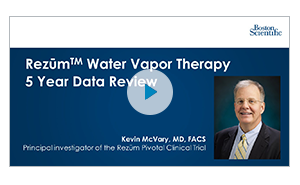
Kevin T. McVary, M.D., F.A.C.S.
Director, Center for Male Health, and Professor of Urology at Stritch School of Medicine, Loyola University Medical Center and Principal Investigator of the pivotal clinical trial
Editorial commentary
Recently, results of a five-year clinical trial confirming the long-term durability of Rezūm™ Water Vapor Therapy for treatment of benign prostatic hyperplasia (BPH) were published in abstract form in the Journal of Urology.1 The study found the Rezūm System, a water vapor thermal therapy, provided significant, sustained improvement of lower urinary tract symptoms (LUTS) and quality of life for patients suffering from BPH out to five years post-procedure. Five-year clinical data is a significant marker for physicians looking at treatments for patients, as it demonstrates long-term durability of results. This data was deemed as a “late-breaking” abstract by the American Urological Association, a distinction typically given to important clinical data that should be transmitted to urologists around the globe and not be delayed as it may impact clinical care.
As the Principal Investigator of the trial, I am pleased to share some key observations as they relate to other therapies currently available.
A closer look
This multicenter, randomized, controlled trial evaluated Rezūm Therapy in men with moderate-to-severe LUTS due to BPH, with the inclusion of the final surgical and BPH medication retreatment rates over five years. There were 135 treated subjects at 15 sites.
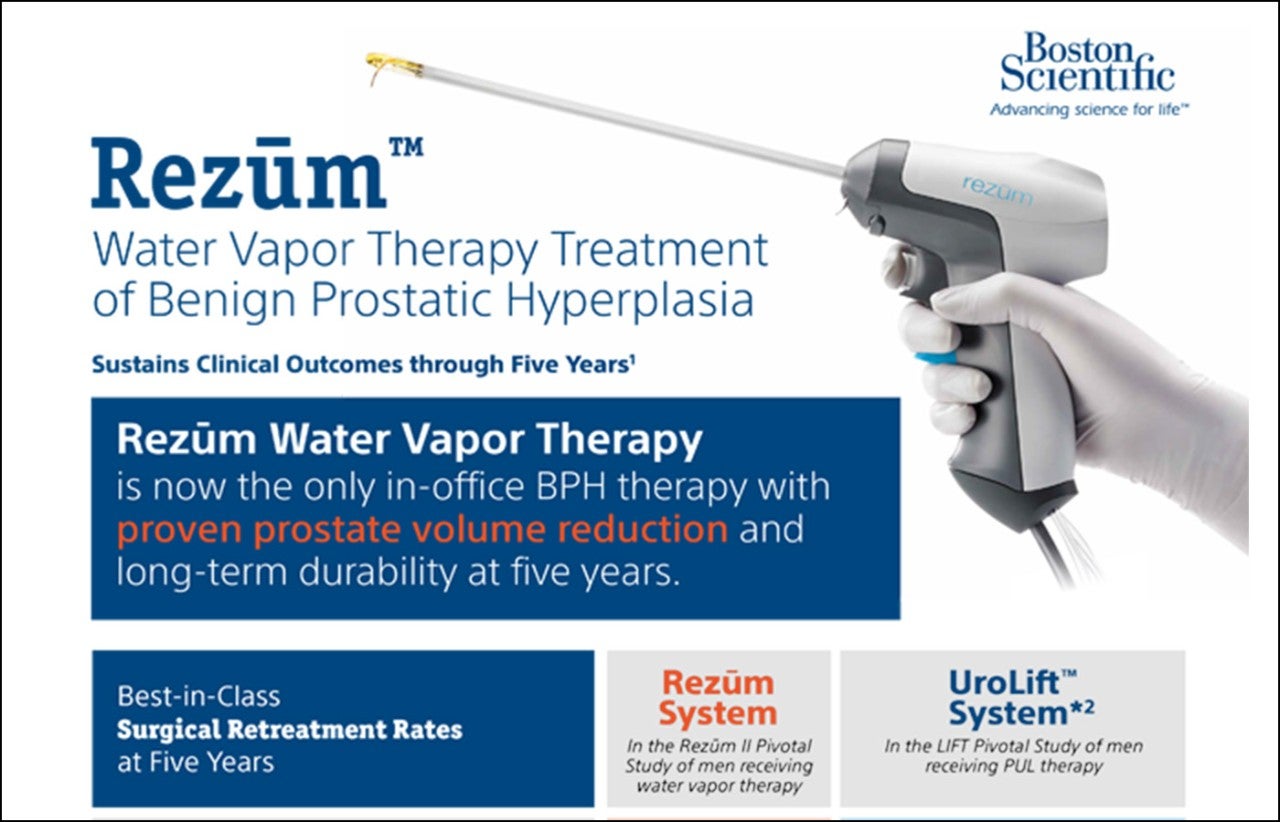
One of the most important markers from this study looked at retreatment rates in the five years after patients were treated with Rezūm Therapy. Patients had a 4.4% surgical retreatment rate and 11.1% initiated medical therapy. Patients were also assessed for symptom relief on the International Prostate Symptom Score (IPSS), peak urinary flow rate (Qmax), and quality of life measures (IPSS-QOL, BPH Impact Index) among others. At five years, patients demonstrated a 48% improvement from baseline in IPSS, a 49% improvement from baseline in Qmax and quality of life improvements from baseline of 46% IPSS-QOL, 49% BPH Impact Index.
Interestingly, this study included patients with a median lobe enlargement (MLE), which occurred in 31.1% of the cohort. Treatment of the median lobe was at the discretion of the physician, and 30 patients with MLE or central zone hyperplasia at the bladder neck received treatment.2 It is speculated that the 4.4% surgical retreatment rate might have been as low as 2.2% as four of the six patients who had retreatment had an enlarged median lobe that was not initially treated during the index procedure.3
Other BPH therapies
To put this into perspective, let’s take a look at another available therapy for BPH — the UroLift™ System. The UroLift pivotal trial, L.I.F.T., was also a multicenter, randomized, controlled trial of Prostatic Urethral Lift (PUL) in men with bothersome LUTS due to BPH. There were 206 subjects at 19 centers. Men with MLE were excluded from the study (about 38% of those screened).4
Through five-years of follow-up of men who received PUL therapy, 13.6% had surgical retreatment and 10.7% were taking medical therapy to treat LUTS. IPSS and Qmax improved by 35% and 50%, respectively, and IPSS-QOL and BPH Impact Index by 44% and 47%, respectively.5
According to the 2019 Updated AUA Clinical Guidelines on LUTS and surgical management, “Given that approximately one third of the initial study population experienced unsatisfactory results necessitating further treatment, patients selecting PUL should be informed that this is a relatively new intervention for LUTS/BPH with uncertainties in long-term durability, though such uncontrolled data are available.”6
Results in practice
In my practice I’ve seen similar positive results with Rezūm Therapy. A busy physician came to me with significant LUTS and medications were no longer working. He underwent Rezūm Therapy and was back to work in his busy office practice and taking care of his own patients in the OR after a weekend. He was also able to discontinue all of his BPH medications. This was a nice outcome demonstrating the fast recovery found with the treatment in this patient.
Conclusion
From my perspective, the five-year data of the Rezūm System reflects excellent durability. These latest results expand upon the growing clinical evidence supporting the long-term durability of the Rezūm System as the leading minimally invasive option for men facing moderate-to-severe BPH-related symptoms. Physicians should continue to be responsive to individual patient clinical needs and patient personal preferences when deciding the most appropriate therapy.
Related content
References
- McVary KT, Roehrborn CG. Five year results of the prospective, randomized controlled trial of water vapor thermal therapy for treatment of lower urinary tract symptoms due to benign prostatic hyperplasia. Late-Breaking Abstract. J Urol. 2020 Apr;203(4):e1021.
- McVary KT, Gange SN, Gittelman MC, et al. Minimally invasive prostate convective water vapor energy ablation: a multicenter, randomized, controlled study for the treatment of lower urinary tract symptoms secondary to benign prostatic hyperplasia. J Urol. 2016 May;195(5):1529–38.
- McVary KT, Rogers T, Roehrborn CG. Rezum water vapor thermal therapy for lower urinary tract symptoms associated with benign prostatic hyperplasia: 4-year results from randomized controlled study. Urology. 2019 Apr;126:171–9.
- Roehrborn CG, Gange SN, Shore ND, et al. The prostatic urethral lift for the treatment of lower urinary tract symptoms associated with prostate enlargement due to benign prostatic hyperplasia: the L.I.F.T. study. J Urol. 2013 Dec;190(6):2161–7.
- Roehrborn CG, Barkin J, Gange SN, et al. Five-year results of the prospective randomized controlled prostatic urethral lift L.I.F.T. study. Can J Urol. 2017 Jun;24(3):8802–13.
- Foster HE, Barry MJ, Dahm P, et al. Surgical management of lower urinary tract symptoms attributed to benign prostatic hyperplasia: AUA Guideline. May 2019. https://www.auajournals.org/doi/10.1016/j.juro.2018.05.048.
Caution: U.S. Federal law restricts this device to sale by or on the order of a physician.
IMPORTANT INFORMATION: These materials are intended to describe common clinical considerations and procedural steps for the use of referenced technologies but may not be appropriate for every patient or case. Decisions surrounding patient care depend on the physician’s professional judgment in consideration of all available information for the individual case.
Boston Scientific (BSC) does not promote or encourage the use of its devices outside their approved labeling. Case studies are not necessarily representative of clinical outcomes in all cases as individual results may vary.
Results from case studies are not necessarily predictive of results in other cases. Results in other cases may vary.
Results from different clinical investigations are not directly comparable. Information provided for educational purposes only.
For information purposes only. The content of this article/publication is under the sole responsibility of its author/publisher and does not represent the opinion of BSC.
Dr. Kevin T. McVary, M.D. is a Boston Scientific consultant and was compensated for his contribution to this article.
All trademarks are the property of their respective owners.