OCCLUDE Registry overview
OCCLUDE: A Prospective, Post-Approval, Open-Label, Multi-Center United States (US) Registry to Evaluate the Effectiveness and Safety of Obsidio Embolic in Clinical Practice.

19
US sites

125
patients

Studying safety and effectiveness
Study objective
This registry assessed effectiveness and safety outcomes of patients who underwent embolization with Obsidio Embolic in a real-world setting.
Primary effectiveness endpoint: Occlusion of the target vessel after embolization with Obsidio™ Conformable Embolic assessed immediately following the index procedure.
Secondary endpoint: Absence of target vessel bleeding without further reintervention within 30 days of the index procedure.
Primary safety endpoint: Freedom from major adverse events through 30 days of the index procedure.
Key study results
Obsidio demonstrated 100% occlusion and no target vessel rebleeding with a low rate of MAEs across diverse clinical applications, target vessels and patient populations in a prospective real-world setting. Every vessel embolized with Obsidio remained occluded and no target vessel reintervention was needed in consecutively enrolled patients.



Favorable safety profile
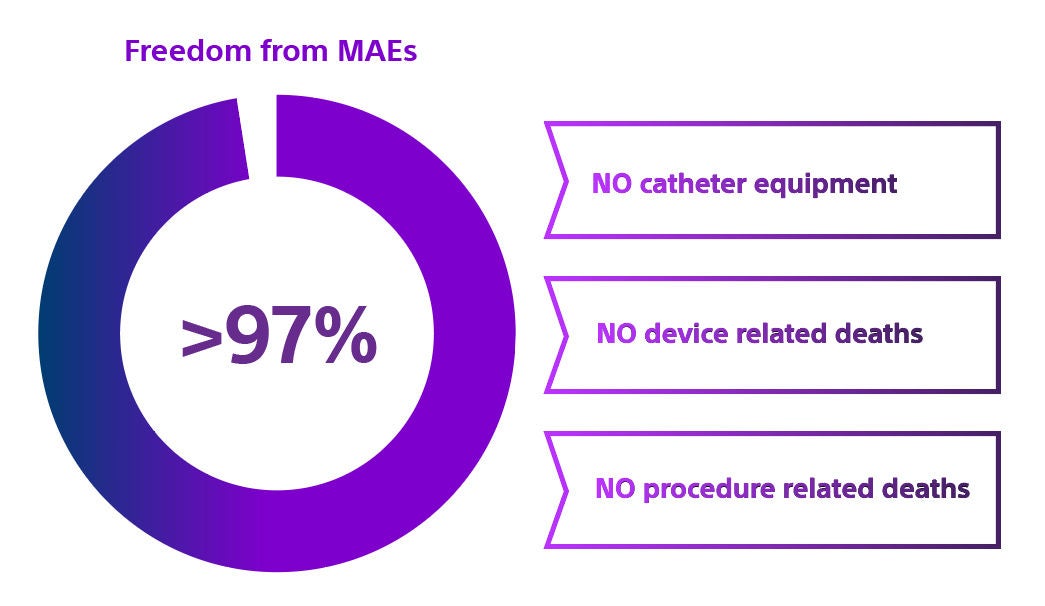
OCCLUDE demonstrated Obsidio Embolic is safe for use in clinical practice across various practitioners with a low rate of MAEs.
Diverse clinical applications. 100% occlusion. 0 rebleeds.
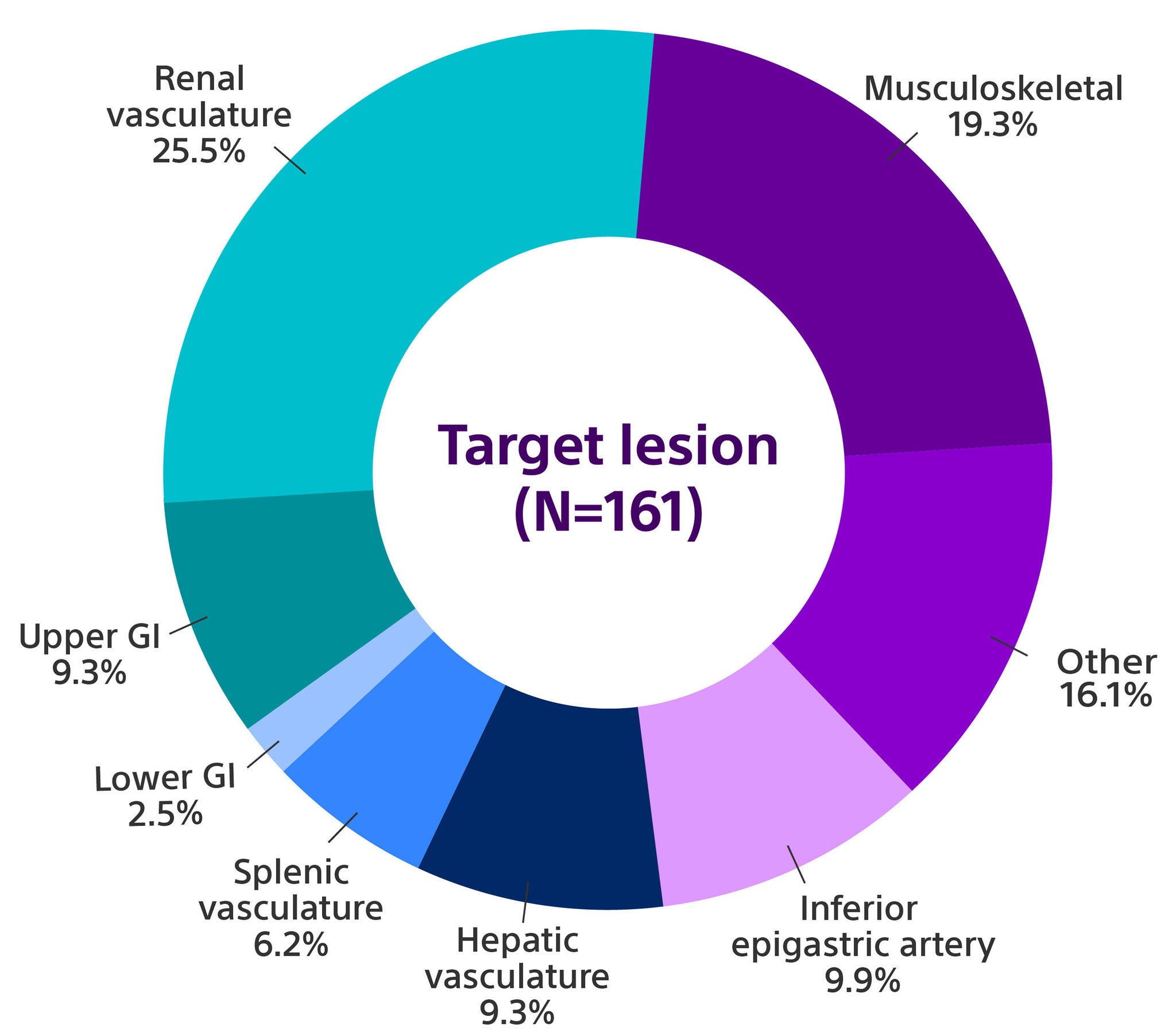
Obsidio Embolic demonstrated 100% occlusion in 19 different target vessels. Obsidio was used in combination with other embolics in 38 vessels and included coils, particles and gelatin sponge.
| Patient characteristics | N=125 |
Age, mean (years) | 59.1 |
Min. – Max. | 18.0-92.0 |
Gender | N (%) |
Male | 79 (63.2) |
Female | 46 (36.8) |
Medical history |
|
Bleeding or clotting disorder | 11 (8.8) |
Prior surgery at target lesion | 14 (11.2) |
Prior embolizations | 4 (3.2) |
History of cancer | 9 (7.2) |
Comorbidities |
|
Hypertension | 68 (54.4) |
Hypercholesterolemia | 43 (34.4) |
Renal insufficiency | 36 (28.8) |
Hepatic insufficiency | 15 (12.0) |
Diabetes | 29 (23.2) |
Coronary artery disease | 19 (15.2) |
Active cancer | 45 (36.0) |
Tobacco use | 12 (9.6) |
Real world experience
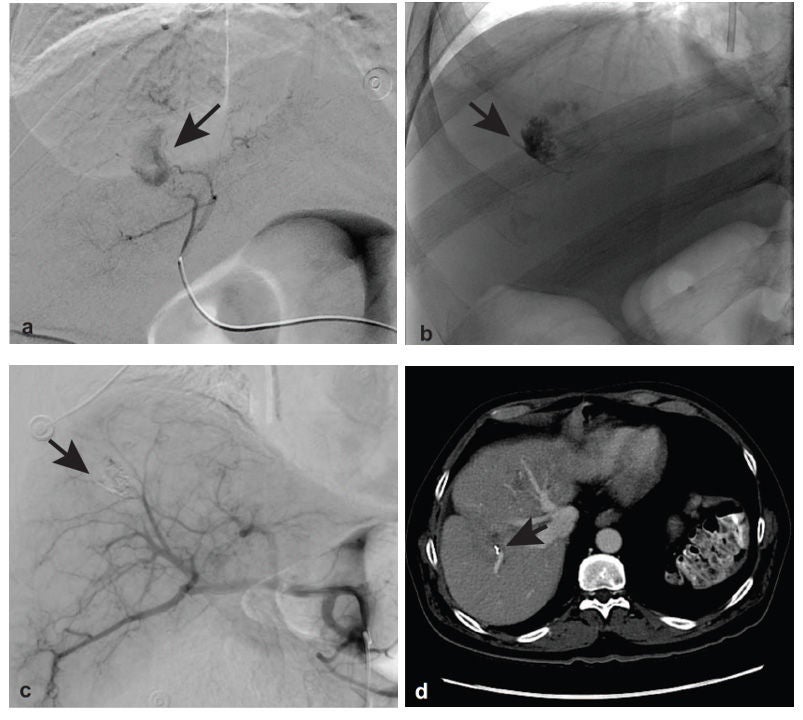
A 74-year-old man with pancreatic adenocarcinoma presented with fatigue and jaundice 3 months post microwave ablation of two hepatic metastases. Hemoglobin was 7 g/dL and total bilirubin was 5.5 mg/dL. (A) Pre-embolization angiogram revealed a large hepatic pseudoaneurysm in the ablation cavity. (B) Obsidio delivery was started distal (arrow) to the pseudoaneurysm. The microcatheter was drawn back during delivery as 0.8 mL of Obsidio was delivered. (C) Post-embolization angiogram demonstrated no contrast filling of pseudoaneurysm. (D) No bleeding was evident on CT at 6-month follow-up. CT demonstrated Obsidio case with no streak artifact (arrow).
View SIR 2026 symposia and hear faculty contextualize the OCCLUDE data with their own procedural experiences and patient outcomes. This expert presentation features Gary Siskin, MD; Rahul Sheth, MD; and Hugh Davis, MD.
Conclusion
The real-world multicenter OCCLUDE study demonstrated favorable effectiveness and safety of Obsidio Embolic in a prospective real-world setting with multiple users.
Obsidio Embolic completely occludes target vasculature across diverse clinical applications, target vessels and patient populations. Every vessel embolized with Obsidio remained occluded and no target vessel reintervention was needed.