Boston Scientific accounts are for healthcare professionals only.

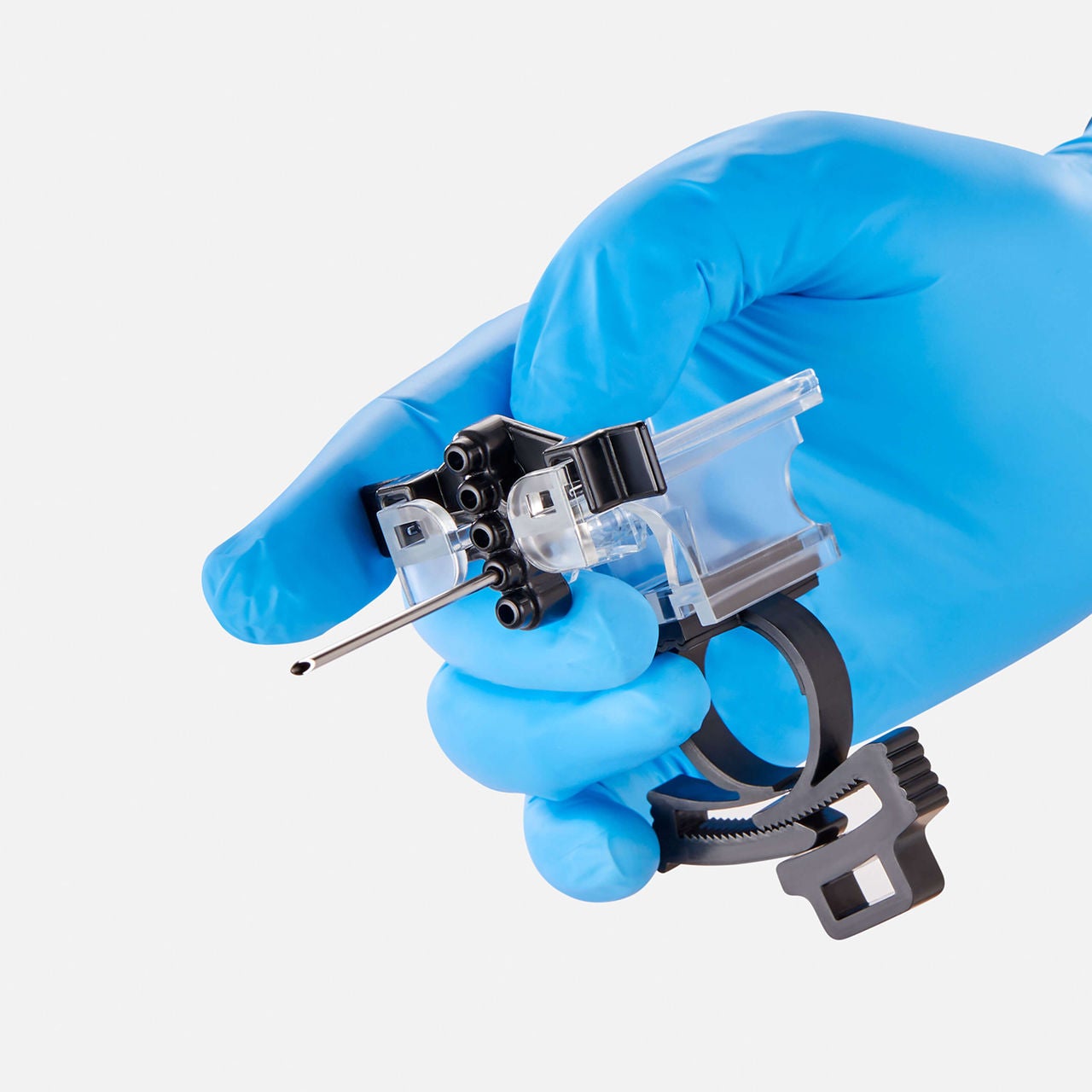
PrecisionPoint™ Transperineal Access System
Reimbursement
Configure or select a product to continue to order
- Overview
- Ordering information
- Training
A new tool for prostate biopsies
The PrecisionPoint Transperineal Access System enables targeted biopsy template samples of the prostate through the perineum.
Why Choose Transperineal Biopsy?
Multiple publications — including the TRANSLATE study — have shown that transperineal biopsies facilitate the detection of clinically significant prostate cancer (≥ GG 2).1–3
One real-world evidence study showed that MR-Bx most often misses cancer in the dorsolateral part of the prostate, while TRUS-Bx misses cancer in the anterior part of the prostate.4 Transperineal biopsies facilitate access to these locations.5
Benefits of transperineal biopsies
- The TRANSLATE study demonstrated a 5.7% greater clinically significant cancer detection rate (≥ GG 2) with LATP compared to standard transrectal biopsy.1
- In the TRANSLATE study, 89% of transperineal biopsies were done without the use of antibiotics.1
- The TRANSLATE study demonstrated a non-significantly different infection rate of 0.002% in TP Biopsy patients without the use of antibiotics and a 1.2% rate in TR patients with the use of antibiotics.1
Why choose the PrecisionPoint Transperineal Access System?
The PrecisionPoint™ Transperineal Access System enables targeted biopsy template sampling of the prostate through the perineum. It's intended to avoid the rectum and only requires two access points.
Benefits of using PrecisionPoint:
- One retrospective analysis suggests that with experience the procedure time for a TP biopsy lowered from 17 to 13 minutes which was similar to site's TR biopsy procedure time of 11 minutes.6
- The PrecisionPoint Transperineal Access System procedure may be done under local anesthesia in an office setting.
- In one study, it was used without bowel preparation (e.g., rectal enema or polyethylene glycol solution).6
Questions?
We are here to help answer any questions you may have about PrecisionPoint.
Ordering information
Order number | Description | Unit |
P1001 | PrecisionPoint Transperineal Biopsy System | Box 20 |
P1002 | PrecisionPoint Transperineal Biopsy System | Box 5 |
Education and training for urology
Online medical training and education courses
The EDUCARE online platform makes medical education and training relevant, comprehensive, personal, and accessible. Register to access procedural videos, case studies, and training resources.


References
- Bryant RJ, Marian IR, Williams R, et al. Local anaesthetic transperineal biopsy versus transrectal prostate biopsy in prostate cancer detection (TRANSLATE): A multicentre, randomised, controlled trial. Lancet Oncol. 2025;26:583–595.
- Lopez JF, Campbell A, Omer A, et al. Local anaesthetic transperineal (LATP) prostate biopsy using a probe-mounted transperineal access system: A multicentre prospective outcome analysis. BJU Int. 2021;128:311–318.
- Tzeng M, Basourakos SP, Patel HD, Allaway MJ, Hu JC, Gorin MA. Pooled outcomes of performing freehand transperineal prostate biopsy with the PrecisionPoint Transperineal Access System. BJUI Compass. 2022;3:434–442.
- Schouten MG, van der Leest M, Pokorny M, et al. Why and where do we miss significant prostate cancer with multi-parametric magnetic resonance imaging followed by magnetic resonance–guided and transrectal ultrasound-guided biopsy in biopsy-naïve men? Eur Urol. 2017;71:896–903.
- Gereta S, Hung M, Alexanderani MK, Robinson BD, Hu JC. Evaluating the learning curve for in-office freehand cognitive fusion transperineal prostate biopsy. Urology. 2023;181:31–37.
- Ultrasound-guided transperineal prostate biopsy. Mayo Clinic. Available at: https://www.mayoclinic.org/medical-professionals/urology/news/ultrasound-guided-transperineal-prostate-biopsy/mac-20473283. Accessed June 9, 2026.