Boston Scientific accounts are for healthcare professionals only.

A treatment option for chronic vertebrogenic low back pain
The Intracept™ Procedure is a minimally invasive, implant-free, outpatient procedure intended to treat chronic vertebrogenic low back pain by ablating the basivertebral nerve.
Identifying vertebrogenic pain
Vertebrogenic pain originates from damaged vertebral endplates. The basivertebral nerve (BVN), found within the vertebrae, carries pain signals from damaged endplates to the brain.
Patients who find relief from the Intracept Procedure often describe pain in the middle of their low back that is made worse by physical activity, prolonged sitting, and bending forward, or with bending and lifting.1

Bending

Lifting

Activity

Sitting
Understanding Modic changes: an objective imaging biomarker
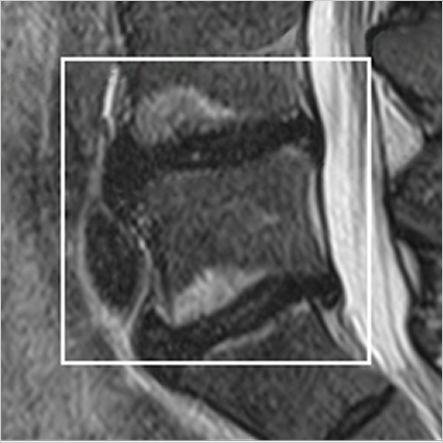
To confirm that a patient has vertebrogenic pain, a pain specialist uses MRI to look for specific changes that occur with endplate inflammation, which are called Modic changes.
The Intracept Procedure is indicated for patients with two types of Modic changes:
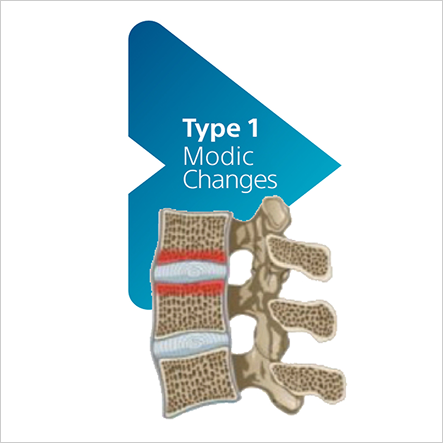
Type 1 Modic changes
Inflammation, edema, vertebral endplate changes, disruption and fissuring of the endplate, vascularized fibrous tissues within the adjacent marrow, hypointensive signals.
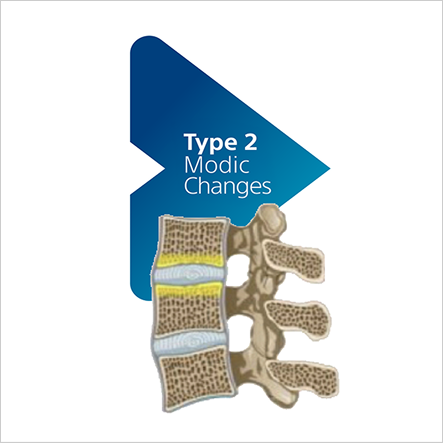
Type 2 Modic changes
Changes to the vertebral body marrow including replacement of normal bone marrow by fat, and hyperintensive signals.
For many years, there wasn't a treatment for people whose MRIs showed Modic changes. For this reason, Modic changes can sometimes be overlooked on an MRI. Modic changes are now recognized as a clear, binary biomarker for vertebrogenic pain.
How the Intracept Procedure Works
See how the Intracept Procedure delivers radiofrequency energy to target the basivertebral nerve within the vertebral body. Unlike typical radiofrequency ablation, basivertebral nerve ablation is proven to provide durable pain relief more than five years after a single procedure.1
1. Fischgrund JS, Rhyne A, Macadaeg K, et al. Long-term outcomes following intraosseous basivertebral nerve ablation for the treatment of chronic low back pain: 5-year treatment arm results from a prospective randomized double-blind sham-controlled multi-center study. Eur Spine J. 2020;29:1925–1934.
View Boston Scientific Spinal Cord Stimulator System Indications, Safety, and Warnings