











The right tools for calcium treatment.
We offer the most advanced and complete Modern PCI solutions
to master all types of coronary calcific lesions.
Calcium Publications Library
Discover the latest clinical evidence for novel Intravascular Lithotripsy. Zoom in on the growing body of evidence for the proven Rotational Atherectomy and Cutting Balloon. Get familiar with the selection of the most recent publications on the treatment of calcified lesions.
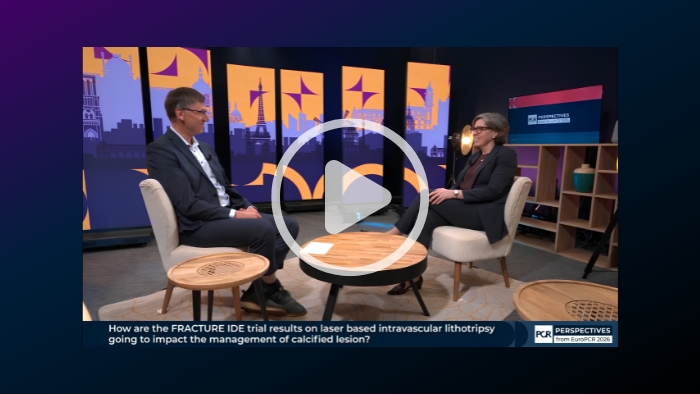
FRACTURE IDE Trial met primary endpoints1
The FRACTURE IDE Trial is a prospective, multicentre, single-arm study using SEISMIQ™ 4CE to treat 420 patients with calcified coronary artery disease (CAD) with primary endpoints assessed at 30 days. Secondary endpoints including long-term safety and effectiveness will be measured through 24 months. This trial was conducted at 46 sites across the US, UK, and EU.
The FRACTURE IDE Trial studied a highly calcified subset of patients and lesions, including 100% site-reported severe angiographic calcium and OCT measurements of 27.4% nodular and arc of 271.9 ± 77.4° at the site of max calcium. The severely calcified de novo coronary lesions were ≥ 2.5 mm and ≤ 4.0 mm; with a lesion length ≤ 40 mm.
PRIMARY ENDPOINTS MET


93.3%
MACE-free at 30 days*
93.7%
Procedural success**
- Safety endpoint excluding peri-procedural MI: 99.3%
- Effectiveness endpoint excluding peri-procedural MI: 99.8%
- Final average MSA of 6.52 mm2
- Average stent expansion of 94.2%†
- Ventricular capture rate of 16.4%‡
The FRACTURE IDE Trial met its primary safety and effectiveness endpoints in the treatment of severely calcified de novo coronary lesions. The device was associated with high procedural success and low complication rate.
ShortCUT: WOLVERINE™ vs. IVL in complex PCI
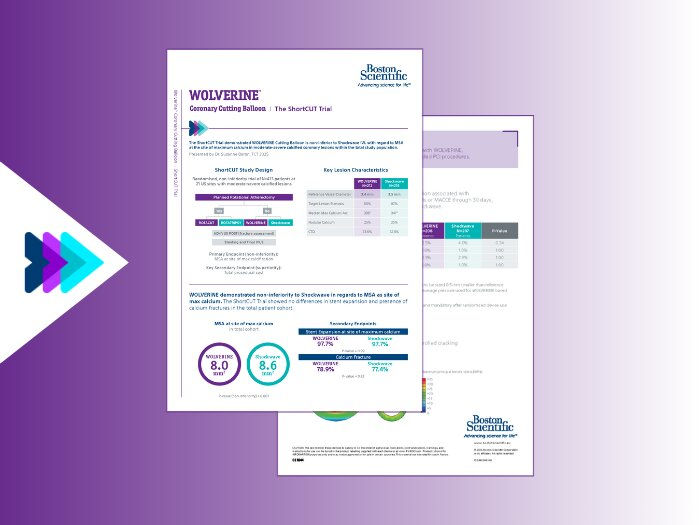
The ShortCUT trial is the first randomised head-to-head study comparing Cutting Balloon and IVL for the treatment of calcified CAD. It evaluated the efficacy of both strategies prior to DES implantation in patients with moderate to severely calcified coronary arteries, with or without planned atherectomy.
In the ShortCUT trial2 , the WOLVERINE™ Cutting Balloon demonstrated non-inferiority to IVL for minimal stent area (MSA) at the site of maximum calcification. No significant differences were observed in stent expansion, calcium fractures, strategy success, intraprocedural adverse events, or 30-day MACCE. In addition, WOLVERINE showed lower total procedural costs.
These results support WOLVERINE Cutting Balloon as a cost-effective, safe, and clinically proven option for IVUS-guided treatment of calcified lesions.
We have deveoped a one-pager that summarizes the results of the trial, you can download it below.
EMJ Interventional Cardiology - Contemporary Techniques to Treat Coronary Calcification

Learn from the experts about the importance of treating calcium, available contemporary techniques and the role of intravascular imaging to improve procedural success.
The recent article, published in European Medical Journal reveals the topics of optimal use of intravascular ultrasound (IVUS), when and how to use techniques such as rotational atherectomy (RA), and how to approach challenging cases such as nodular calcified lesions or bifurcation lesions.
Key points:
- Intravascular imaging is key to the appropriate use of calcium modification techniques and achieving good stent expansion.
- Integrating IVUS to the complex PCI workflow improves results and saves both time and contrast medium.
- Ideally, IVUS should be used pre-, peri-, and post-PCI to select the most appropriate calcium modification tool and assess its effect.
- RA can facilitate procedural success, enabling the treatment of otherwise uncrossable or undilatable lesions.
- Most potential complications are predictable and are technique dependent
COPS: Cutting Balloon to Optimise Pre-dilatation for Stenting
COPS: Cutting Balloon to Optimise Pre-dilatation for Stenting 1-year outcomes, utilizing the WOLVERINE™ Cutting Balloon, are available now! Access the latest data presented at TCT 2022.
This prospective, randomized, multicenter open-label trial, enrolling 100 patients with significant calcified lesions, evaluated at IVUS by an independent corelab, demonstrated WOLVERINE to be a safe and effective option for modifying even severely and moderately calcified lesions.
Clinical Research in Cardiology
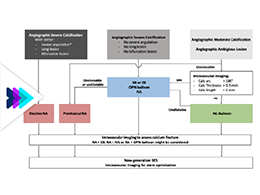
Rotational atherectomy of calcified coronary lesions: current practice and insights from two randomized trials
Abdelhakim Allali et al evaluated the technical evolution in RA practice based on a pooled analysis of the ROTAXUS and PREPARE–CALC trials, analyzing the available experience with RA in different patient and lesion subsets and sharing recommendation proposals to improve RA practice.
Review the recent paper published in the March 2022 edition of the Clinical Research of Cardiology journal.
Access the publication now > (opens link on Springer website)


Education & Training with EDUCARE
Advancing science for more collaborative solutions to patient care
Together, we advance science for life.

Join our Complex PCI Community
Stay up-to-date via email on the latest advances in complex PCI


Request a Sales Rep
Fill out a quick form and one of our sales representatives will be in touch to answer any question you have.
Product catalogue
Download our product catalogue and stay up to date on our latest innovations.