










The Evolution and Future of Pancreaticobiliary Disease Management
Perspectives from Thought Leaders
Thought leaders Sri Komanduri, M.D., Mouen Khashab, M.D., and long-time Boston Scientific executive, Michael Phalen discuss how technological advances over the past 30 years have advanced pancreaticobiliary disease management, its impact on the field today and potential for the future.
HOW HAVE YOU SEEN THE FIELD OF PANCREATICOBILIARY DISEASE MANAGEMENT EVOLVE?
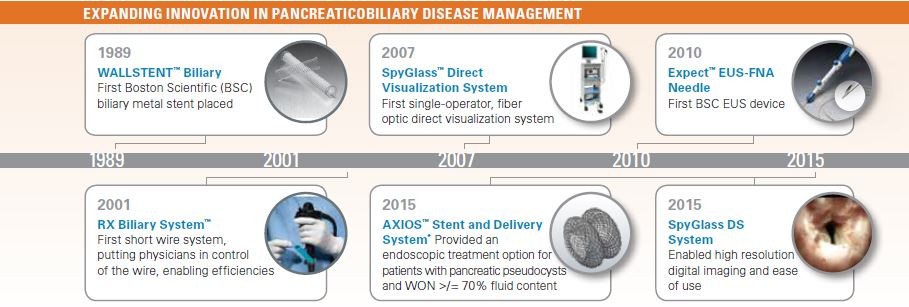
 “The evolution of pancreaticobiliary disease management started with simple ductal access and fluoroscopic imaging in the late 1980’s and early 1990’s. At that time, we began developing single-use diagnostic, therapeutic and palliative devices including a comprehensive portfolio for pancreaticobiliary intervention. For most of the 1990’s we focused on wire-guided biliary devices and in early 2000, we introduced the rapid exchange platform which allowed physicians to control the wire for biliary access. The RX Biliary System™ helped increase efficiencies which led to facilitating shorter procedures and potentially reduced risk of complications for patients[1].
Another significant milestone came in 2007 with the introduction of the world’s first single operator cholangioscopy system, the SpyGlass™ Direct Visualization System. In 2015, the move from fiber optic to digital technology with the SpyGlass DS System advanced procedural efficiency with faster set-up, ease of use and improved image quality.”
– Michael Phalen
WHAT ADVANCEMENTS HAVE CHANGED THE FIELD OF CHOLANGIOSCOPY?
 “The optics and technical ability to perform cholangioscopy have evolved dramatically over the past ten years allowing us to utilize the procedure in a much more effective manner clinically. As the technology continues to evolve, we expect the procedure to become more efficient and potentially expand to new applications.”
– Sri Komanduri, M.D.
 “My overall treatment algorithm has changed as cholangioscopy has evolved. For indeterminant strictures, rather than repeat cytology brushing, I now just go straight to cholangioscopy because of the ease of use and excellent visualization. And because of the excellent targeting, efficiency, and safety, I now use cholangioscopy with lithotripsy rather than mechanical lithotripsy when treating large stones.”
– Mouen Khashab, M.D.
ARE THERE SPECIFIC ADVANCEMENTS RELATED TO ERCP AND EUS PROCEDURES THAT YOU BELIEVE WILL CONTINUE TO IMPACT THE FIELD?
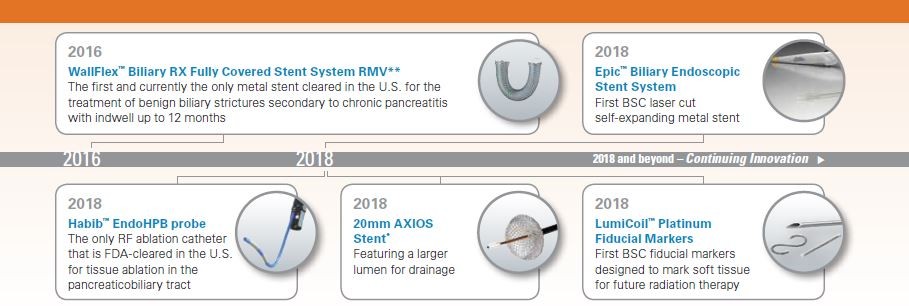
“Cholangiopancreatoscopy has been at the forefront of what’s new in ERCP, and the indications are expanding, such as the use of pancreatoscopy in patients with intraductal papillary mucinous neoplasm. The field of interventional EUS and the sampling of lesions and fine needle biopsy have seen marked improvements. FNB needles have allowed us to sample pancreatic and other tumors and reduce the need for repeat biopsies and ROSE.”
– Mouen Khashab, M.D.
“The emergence of EUS-based procedures is creating a shift from ERCP to EUS. I think this trend will continue as EUS provides less risky and more efficient ways to access the pancreas and gallbladder with fewer steps. EUS procedures will also provide patients with less invasive procedures and reduce their risk of complications, especially post-ERCP pancreatitis.”
– Sri Komanduri, M.D.
HAVE YOU SEEN ERCP AND EUS PROCEDURES BECOME LESS INVASIVE?
“Yes, this shift has already been taking place in areas such as fluid collection management. With the emergence of interventional EUS, I believe minimally invasive treatment options will continue to evolve in this direction as it relates to bypassing cancers. We will also see new applications for lumen apposing metal stents, drainage, access, tissue acquisition, anastomosis creation and tumor resection. I think we will continue to see a reduction in the number of surgical procedures as these new applications and therapies are introduced.”
– Sri Komanduri, M.D.
LOOKING TO THE FUTURE WHAT ARE SOME NOTEWORTHY TRENDS RELATED TO PANCREATICOBILIARY DISEASE MANAGEMENT?
“Continued advancements in EUS will result in less invasive procedures with reduced risk profiles and will create new avenues for diagnosing and treating cancers. Ultimately, future advances will allow us to continue to reduce risk and complications while helping people live longer.”
– Sri Komanduri, M.D.
“As an endoscopy business we have been, and continue to be, committed to biliary intervention. The need for endoscopic intervention will continue to increase with an aging population and as we enter new markets globally. We will continue to enhance our portfolio to develop less invasive solutions to provide better care for patients with underlying biliary diseases. One constant in our evolution is that our innovations are always patient-centric and customer-focused. We partner with physicians to understand the challenges they face, and will continue to work together to answer the unmet needs and ensure we are delivering the highest standards of quality.”
– Michael Phalen
Profiles

SRINADH KOMANDURI, M.D., MS
Dr. Srinadh Komanduri is the Medical Director of GI Lab, Director of Interventional Endoscopy and Associate Professor of Medicine and Surgery in the Division of Gastroenterology and Hepatology at the Northwestern University’s Feinberg School of Medicine. He is also affiliated with Northwestern Lake Forest Hospital. Dr. Komanduri received his medical degree from the University of Miami Miller School of Medicine and performed his Advanced Therapeutic Endoscopy Fellowship at RUSH University Medical Center in Chicago, Illinois.
MOUEN KHASHAB, M.D.
Dr. Mouen Khashab is Associate Professor of Medicine at Johns Hopkins Hospital and is the Director of Therapeutic Endoscopy in the Division of Gastroenterology and Hepatology at Johns Hopkins. He is nationally and internationally known in the field of interventional endoscopy and has contributed immensely in recent years to the advancement of interventional endoscopy as a minimally invasive means to treat various gastrointestinal and pancreaticobiliary disorders. Dr. Khashab completed is medical school at American University of Beirut and residency in internal medicine and fellowship in Gastroenterology at Indiana University.
MICHAEL PHALEN
Michael Phalen recently retired as Executive Vice President and President, Medical Surgery for Boston Scientific after 29 years with the company. Phalen was also President of Boston Scientific International responsible for planning and executing the organization’s international growth strategy, and President of Boston Scientific’s Endoscopy business from 2001 to 2011.